
POST The government is completely and utterly wrong about surcharging

When I was in sunnier climes earlier this month, I was asked a couple of times about a particularly bonkers British government policy announcement concerning card payments. More than one person from overseas regulators asked me about it, in fact. They asked me if I could explain our government’s reasoning behind their policy announcement about card payment surcharges. Which was:

From January next year, businesses will not be allowed to add any surcharges for card payments. The worst offenders currently are airlines and food delivery apps, and small businesses which typically add a fee for cards. In 2010 alone consumers spent £473m on such charges, according to estimates by the Treasury.

From Credit and debit card surcharges to be banned - BBC News

Unfortunately, I cannot. This is just plain dumb. If you are going to interfere in a market and start price-fixing, then you should do it to increase the net welfare, not to provide a hidden subsidy to the well-off. I imagine what happened is that the partner of a government minister went online to book a mini-break to Dubrovnik, searched for the cheapest flights, went to pay with their black Amex card and got upset about being charged a surcharge that they could well afford to pay. Next thing you know, it’s government policy that rich users of rewards cards must be subsidised by everyone else. Baffling.

The move will save British consumers hundreds of millions of dollars

From U.K. Bans Credit Card Surcharges, Calling Them A 'Rip-Off' : The Two-Way : NPR

Really? How? The credit card system (and all the legal protections that come with it) do not suddenly become free. British Airways still has to pay a merchant service charge (MSC) to their acquirer and the acquirer still has to pay an interchange fee (already capped by the EU). If British Airways can’t charge me an extra £2.50 for using my credit card so that I can get extra Avios, then they will simply add £1 “booking fee” or whatever to all tickets. Now, people who pay with their debit cards (who used to pay nothing extra) are paying an extra £1 and I’m paying £1.50 less and still getting my Avios.

There are two issues here: should merchants be allowed to surcharge (hint: yes) and should the government interfere in the surcharging (more on this later).
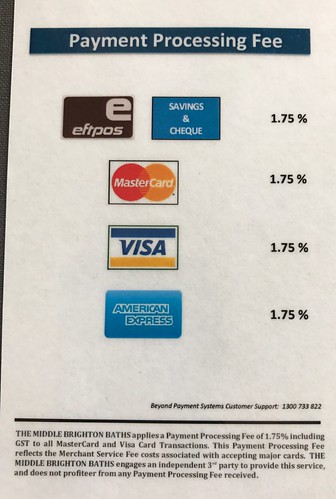
 Surcharging in Melbourne

xxx 

xxx 

Comments

Popular posts from this blog

new survey results from USA Technologies (USAT) suggest. The payments technology company, which enables electronic payments for self-service machines, compared consumer spending activity at 35 of its vending machines in urban areas with a high concentration of iPhone users between week one and week four of the installation of new digital signage promoting Apple Pay. Consumers made more contactless purchases: The vending machine providers saw an average contactless transaction revenue increase of 89%, implying that consumers are making more mobile payments. This was likely driven by the clear advertisement of Apple Pay. Total transactions increased: Consumers made more purchases overall. This was probably driven by an uptick in mobile payments, given the major increase in contactless transaction revenue. And the vending machines may have attracted many first-time users who were drawn in by the digital advertising of Apple Pay. Boosting awareness is key to unlocking pent-up demand amon...

David | LinkedIn

Alex Todd rather kindly called this a “most lucid explanation of digital identity management” I would highly recommend this presentation to anyone interested in understanding prospective blockchain based identity architectures From David | LinkedIn This is very kind, but as I said in the link, this is thinking out loud and far from a fully-developed solution. We’re working on parts of this for different clients and I can see that there is something there - a genuinely new way of solving some old problems - but it’s early days.

Financial Cryptography: Corda Day - a new force

Forum friend Ian Grigg, who I always take very seriously indeed on any such topic, wrote about Corda on his blog and concluded with a powerful statement. Bitcoin told the users it wanted an unstoppable currency - sure, works for a small group but not for the mass market. Ethereum told their users they need an unstoppable machine - which worked how spectacularly with the DAO? Not. What. We. Wanted. Corda is the only game in town because it's the only one that asked the users. It's that simple. From Financial Cryptography: Corda Day - a new force xxx It seems to me, however, what Ian is pointing to as the greatest strength of their approach is also the greatest weakness. A staple feature of unimaginative management consultants presentations about innovation is some variation on the statement by Henry Ford that if you had asked users what they wanted, they would have asked for faster horses coupled with some variation on the statement by Steve jobs that it was pointless ask...